

The decision between a conventional (Fannie Mae/Freddie Mac) loan and a Debt Service Coverage Ratio (DSCR) loan for investment property acquisition has never been purely about interest rate. In 2025, regulatory changes, high home prices, and shifting employment landscapes have made the tactical advantages of DSCR loans clearer than ever, creating a new math for modern investors.
The $832,750 Limit: Higher, But Still Constraining
For 2025, the Federal Housing Finance Agency (FHFA) has raised the baseline conforming loan limit for a single-unit property to $832,750 in most areas of the country. In high-cost counties, the limit can stretch up to $1,249,125. While this increase ($26,250 over the 2024 baseline) provides greater accessibility to conventional financing for primary residence buyers, it often falls short for investors targeting competitive Tier 1 rental markets.
Investors aiming for a multi-unit property or a prime single-family rental in metros like Los Angeles, Seattle, or New York often find that even the high-cost area limit is insufficient for maximizing leverage. DSCR loans, which operate outside of Fannie Mae and Freddie Mac restrictions, are only limited by the property’s cash flow, offering the financial flexibility needed to purchase higher-value assets without resorting to complex jumbo financing.
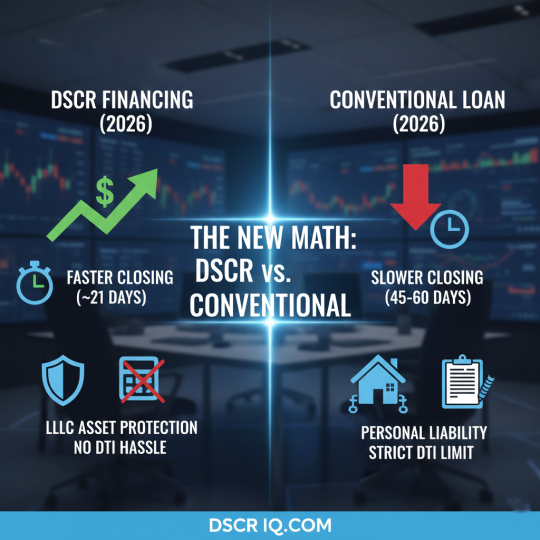
The “DTI” Headache: Why Conventional Loans Penalize the Modern Investor
As the gig economy, self-employment, and contract work become the norm, more investors struggle with the conventional loan’s strict qualification hurdle: the Debt-to-Income (DTI) ratio. Conventional guidelines require extensive personal income documentation (two years of tax returns for the self-employed) and generally cap DTI at 50% (often lower for manual underwriting).
For a savvy real estate investor, reducing taxable income through deductions is a core wealth-building strategy. However, this perfectly legal and sound tax practice drastically lowers the gross income reported to a conventional lender, spiking the DTI ratio and leading to loan denial.
DSCR loans eliminate this “DTI trap.” Approval is based solely on the property’s projected gross rental income divided by the proposed mortgage payment (PITI). This asset-based underwriting is essential for freelancers, portfolio managers, and high-net-worth individuals who generate income in ways traditional lenders can’t easily document.
Asset Protection: The LLC Shield Remains Gold Standard
The Corporate Transparency Act (CTA), which went into effect in 2024, requires investors using LLCs to report beneficial ownership information to the federal government (FinCEN). This regulatory change has reduced the anonymity of using an LLC. However, the fundamental benefit of the LLC—liability protection—remains fully intact.
Conventional loans require the individual to be the borrower, making it extremely difficult to close a property directly into an LLC without immediately violating the loan’s non-assignment clause (the dreaded “due-on-sale” clause). DSCR loans, designed for investors, explicitly permit closing the loan directly in the name of the LLC. This single feature provides a critical separation between the investor’s personal assets and the investment’s liabilities, safeguarding personal wealth from tenant lawsuits or property-related claims—a protection far more valuable than the administrative burden of CTA reporting.
Speed: Time is Money in 2026
In a competitive market where investor profits are often defined by closing certainty and speed, the gap in transaction timelines is a major deciding factor.
- DSCR Loan Timeline: With streamlined, property-only underwriting, DSCR loans typically close in 21 to 28 days. The elimination of personal income verification removes the single greatest friction point in the lending process.
- Conventional Loan Timeline: Due to exhaustive personal financial verification and stricter compliance checks, conventional investment property loans often require 45 to 60 days to close.
The ability to close a property 3 to 5 weeks faster allows DSCR borrowers to present more competitive, attractive offers to sellers, often winning the bid even if their offer price is slightly lower than a conventional buyer’s.
